01Maturity and complexity: the calibration axis
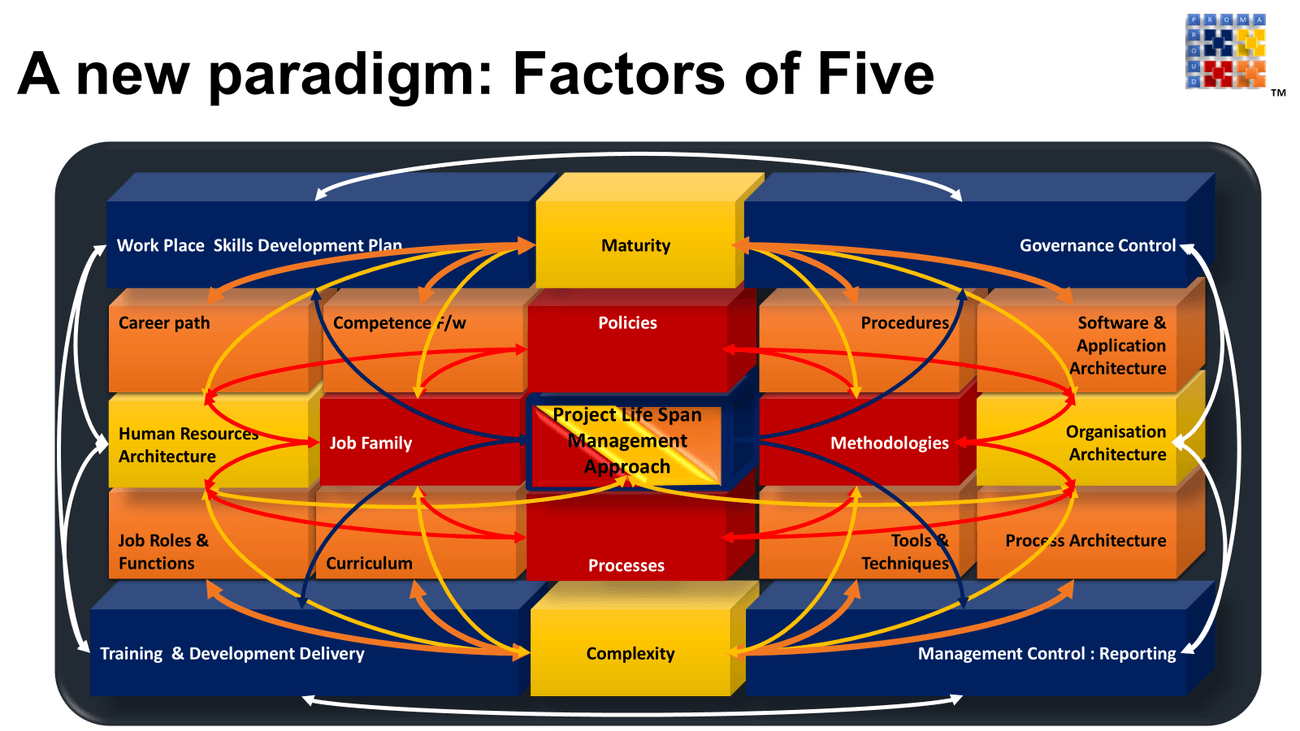
Two of the most important contextual forces in the model are organisational maturity and programme or project complexity. Complexity creates the demand placed on the delivery system; maturity reflects the organisation's current ability to respond to that demand consistently and effectively. The relationship between these two factors determines how much structure, governance, assurance, specialist competence, management attention and formal control are appropriate. A highly complex initiative in a low-maturity environment requires a different management response from a routine initiative in a mature organisation. The Factors of Five model makes this relationship explicit so that governance and delivery arrangements can be proportionate to the real level of risk and capability.
02Governance, management control and reporting
Governance Control and Management Control: Reporting form the oversight and feedback system around delivery. Governance establishes decision rights, accountability, escalation paths, tolerances, assurance expectations and the boundaries within which management operates. Reporting converts operational information into management evidence, allowing performance, risk, compliance and emerging issues to be monitored. Together they create a closed control loop: governance defines what must be controlled and why; management information shows what is actually happening; and the resulting insight supports decisions, corrective action and continuous improvement.
03People, competence and organisational capability
On the people and capability side, the model links the Workplace Skills Development Plan, career paths, competency frameworks, Human Resources Architecture, job families, job roles and functions, curricula, and training and development delivery. This makes competence development part of the operating model rather than a separate human-resources activity. The objective is to create traceability from the work that must be performed, to the roles responsible for that work, to the competence required, and finally to the learning and development interventions needed to build or sustain that competence. In this way, capability development is directly connected to programme and project delivery requirements.
04Policies, methodologies, processes and procedures
The central management system is formed by policies, methodologies, processes and procedures. Each plays a different role. Policies define organisational intent and mandatory boundaries. Methodologies translate those expectations into a coherent way of managing programmes and projects. Processes define repeatable flows of work and accountability, while procedures provide the detailed instructions needed for consistent execution. The Project Life Span Management Approach connects these elements and ensures that they are applied at the right point in the delivery life span. This creates consistency without forcing every programme or project into the same level of formality.
05Architecture, tools and digital enablement
On the enabling side, the model connects tools and techniques, Process Architecture, Organisation Architecture, and Software and Application Architecture. This recognises that delivery performance is shaped not only by what the organisation says should happen, but also by how work is structured and by the systems through which information, workflow, evidence and decisions are managed. A methodology that is not reflected in process design, organisational roles or enabling software will remain difficult to institutionalise. Conversely, software cannot compensate for unclear processes, weak governance or insufficient competence. The model therefore treats technology as an integrated enabler of the management system rather than as the management system itself.
06Interrelationships are the point of the model
The arrows in the model are as important as the individual blocks. They illustrate that the components are interdependent and that improvement must be managed as a system. For example, increasing project complexity may require stronger governance, different competencies, more rigorous methods, additional assurance, revised reporting and more capable tools. A change to organisational policy may require corresponding changes to processes, procedures, role definitions, training content and software workflow. Improvements in maturity may, in turn, allow greater delegation, more efficient control and more adaptive ways of working. This systems perspective helps prevent a common failure in transformation initiatives: optimising one component while leaving the surrounding system unchanged.